
1. Business environment for home appliances
The business environment for home appliances in FY2026 is becoming increasingly uncertain due to the sharp rise in crude oil prices caused by the deteriorating situation in the Middle East, as well as the resulting rise in home appliance prices and shortages of components.
In addition, factors such as a pullback following the surge in PC demand caused by the end of Windows 10 support in the previous fiscal year and market fluctuations such as the launch of new video game consoles are expected to make navigating our business challenging. On the other hand, we also anticipate solid positive factors, such as replacement demand ahead of the “FY2027 air conditioner problem” (expected price increases as Japan tightens energy-efficiency standards for air conditioners in April 2027). We will remain highly responsive to these changes in the market and among our customers, implementing agile marketing strategies that quickly incorporate customer needs to ensure the achievement of our management plan. With this concept as our foundation, we will strongly promote the three priority strategies put forth in Joshin Reborn Action 2026.
2. Full-scale entry into PB products
The full-scale rollout of our private brand (PB) products is the most critical factor in driving our sustainable growth and bolstering our profitability. Our traditional proprietary product lineup faced the challenge of a high proportion of IT products, such as personal computers, which left its contribution to profitability limited.
To fundamentally resolve this situation, in October 2025, we established a new Product Development Office within the Merchandise Department, our procurement department. This move has streamlined the process from planning through development to business negotiations, and we have established a structure to pursue the development of proprietary PB products in earnest.
Since June 2026, we have been gradually introducing products to the market, ranging from kitchen and home appliances, such as handheld vacuums, microwaves, and toasters, to consumables. Going forward, we will expand to major appliance categories, such as refrigerators, washing machines, and air conditioners, and accelerate development and business negotiations with a relentless focus on delivering optimal value for money and reliable performance for our customers. We are fully committed to achieving our FY2028 targets of a 10% share of sales for PB products and a PB product development target of 500 items or more.
3. Establishing the OMO strategy
Joshin’s second strategy is to further develop our OMO membership strategy, which organically integrates our e-commerce business, one of our core strengths, with our stores. Expanding the number of mutualuse members, who use both our stores and e-commerce, will boost the overall number of active members and directly contribute to increased sales and profits. We are implementing a concrete action plan centered on the Joshin app.
First is the in-store pickup service, an initiative designed to encourage customers who make purchases on our e-commerce site, Joshin Web Shop (hereafter, “J-web”), to visit our physical stores. This service, which allows customers to pick up products at a nearby store with free shipping, combined with the distribution of in-store pickuponly coupons, is driving a steady increase in the number of mutual-use transactions. Next, to target customers who shop exclusively in-store, we launched a related-product recommendation initiative in June 2026. Based on a customer’s in-store purchase history, this system automatically delivers web-exclusive coupons for related products through the app. For example, by using the app to recommend dedicated dust bags and send coupons to customers who have purchased a vacuum cleaner instore, we are effectively encouraging customers with no previous online purchasing experience to use our e-commerce site, and the number of mutual-use members is steadily increasing. By integrating digital and physical channels, we are providing each and every customer with a customized, optimal experience.
4. Strengthening the outlet strategy
The third strategy is our outlet strategy. By linking our stores, e-commerce, and reuse business, we are aiming to drastically reduce slow-moving inventory and establish an appropriate management structure based on appropriate product inventory levels.
As a specific measure, we established a scheme to promptly consolidate display inventory and slow-moving inventory scattered across individual stores at our two logistics centers in eastern and western Japan. The consolidated inventory is then sold intensively at our outlet stores. This dramatically accelerates the speed of new product introductions at regular stores, allowing us to maximize profits while keeping our stores fresh. At the same time, after consolidating each store’s slow-moving inventory at the logistics centers, we have established multiple sales channels utilizing J-web and reuse centers. Looking ahead, with an eye toward expanding our outlet stores through business format changes, we will promote balance sheet management to enhance asset efficiency.
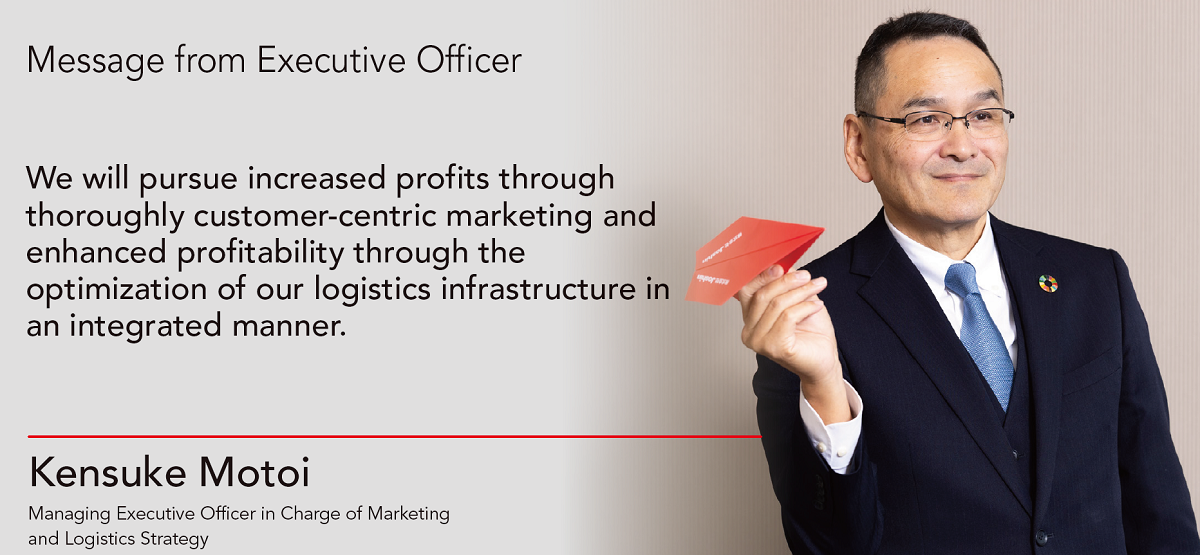
We will implement our marketing and logistics strategies centered on the three priority strategies outlined above: (1) PB product strategy, (2) OMO strategy, and (3) improvement of product inventory turnover through our outlet strategy. We will steadily execute these marketing and logistics strategies in tandem to drive the transformation into a new Joshin with appropriate product inventory levels and a solid earnings base.