To strengthen corporate governance, the Board of Directors Evaluation Committee, comprised only of outside directors, takes the lead in analyzing and evaluating the effectiveness of the Board of Directors and related matters each fiscal year, and the Company takes continual action to improve effectiveness based on that.

- Deepening medium- to long-term growth strategies and promoting more efficient management with a focus on cost of capital
- Enhancing the Board of Directors’ monitoring functions and ability to respond flexibly and quickly
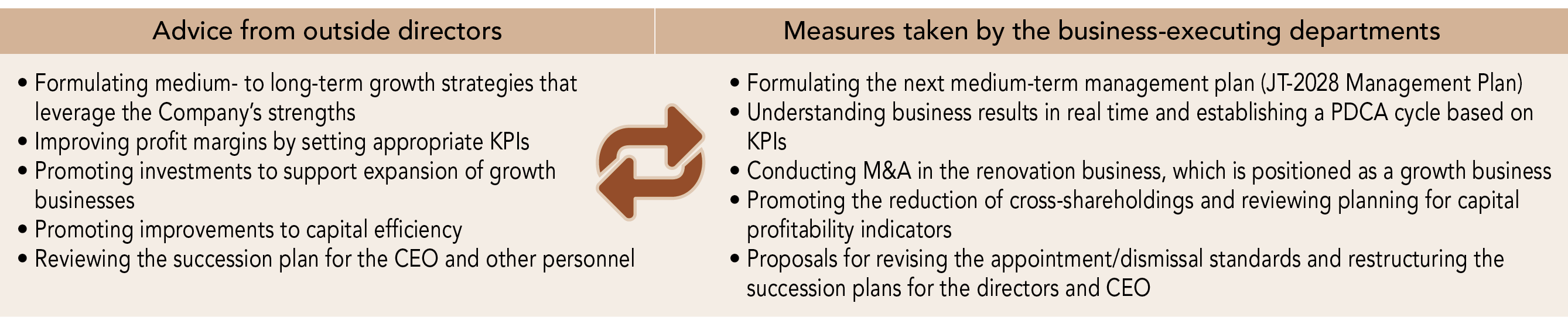
- Formulated and disclosed the medium-term management plan (JT-2028 Management Plan) ahead of schedule to facilitate dialogue with shareholders and investors
- Conducted M&A to expand and strengthen the renovation business, which is positioned as a growth business
▶After spending time to achieve the recent recovery in business results, refining growth strategies in greater detail remains an ongoing issue
▶After reconsideration, revised downward the ROE target values and positioned the bolstering of earning power as the highestpriority issue
- Strengthened the PDCA function by setting important KPIs for improving the gross profit margin and operating income ratio
- Introduced approval standards focused on ROI for investments in newly establishing, renovating, or changing the business format of stores
- Promoted improved inventory efficiency and greater freshness on the sales floor by leveraging outlet sales
- Promoted continued reduction of crossshareholdings
- Introduced ROE as an indicator used to calculate the performance-linked stock-based compensation of executive officers, with application from FY2026
- As a result of delegating authority to the business-executing departments following the transition to a company with an Audit and Supervisory Committee, established a system where the Board of Directors can concentrate on big-picture discussions, such as medium- to long-term growth strategies and financial and capital policies
- Set the annual agenda for the Board of Directors in advance and created a dashboard for important KPIs
- Revised the appointment/dismissal standards for the directors and CEO
- As a result of revising the succession plan, established three new human resource pools—candidates for the next directors, candidates for the next executive officers, and candidates for future senior management—started development programs for them
▶Bolstering communication between the supervision side and the business execution side (eliminating asymmetry of information) is an issue
- Points rated as highly effective
• Following the transition to a company with an Audit and Supervisory Committee, the foundations of a monitoring framework have been built, and timely and accurate business results monitoring has started to function.
• The Board hosts an active exchange of opinions, drawing on the diverse expertise of the outside directors.
- Points where improvement and enhancement initiatives are expected
• The intended form of the partnership between supervision and execution (that is, the respective division of roles) was partly unclear.
• There is room for improvement in expressing big-picture perspectives such as strategic significance, investment effects, and risk assessments for the proposals submitted by the business-executing divisions to the Board of Directors.
• Management strategies must be further refined through dialogue with stakeholders (IR activities).
- Result of the evaluation of the effectiveness of the Board of Directors
•It was determined that the effectiveness of the Board of Directors is generally being upheld.

- Deepening medium- to long-term growth strategies and promoting more efficient management with a focus on cost of capital
- Strengthening coordination between the Board of Directors and the Board of Executive Officers and enhancing monitoring functions
Training for Officers
In FY2025, we continued our initiatives for improving officer skills based on the skills matrix. Training through outside courses was carried out, focusing on obtaining up-to-date knowledge and building up skills that are lacking in individual directors, Audit & Supervisory Board members, and executive officers among the “management skills” and “skills related to business specialization” listed in the skills matrix (p. 84). As one part of the succession plans, the system was made so that directors and executive officers are appointed as chief officers responsible for sustainability and risk management, and practical training is also carried out for the acquisition and updating of the skills required for management through actual work.
|
Management skills |
Number of training courses taken |
|
Corporate management |
15 |
|
Finance, accounting, and capital policy |
8 |
|
Legal affairs and governance |
15 |
|
Management planning and business strategies |
7 |
|
HR, labor relations, and diversity |
5 |
|
ICT/DX |
1 |
|
Environment and energy |
1 |
|
Total |
52 |
|
Specialized skills |
Number of training courses taken |
|
Home appliance retail business |
2 |
|
Housing environment business |
0 |
|
Marketing |
4 |
|
Logistics |
0 |
|
Total |
6 |
Notes:
Transitioned to a company with an Audit and Supervisory Committee in June 2025
Each director, Audit & Supervisory Board member, and executive officer took two courses.