.jpg)
Issues Facing Joshin and Recommendations for Improving Corporate Value
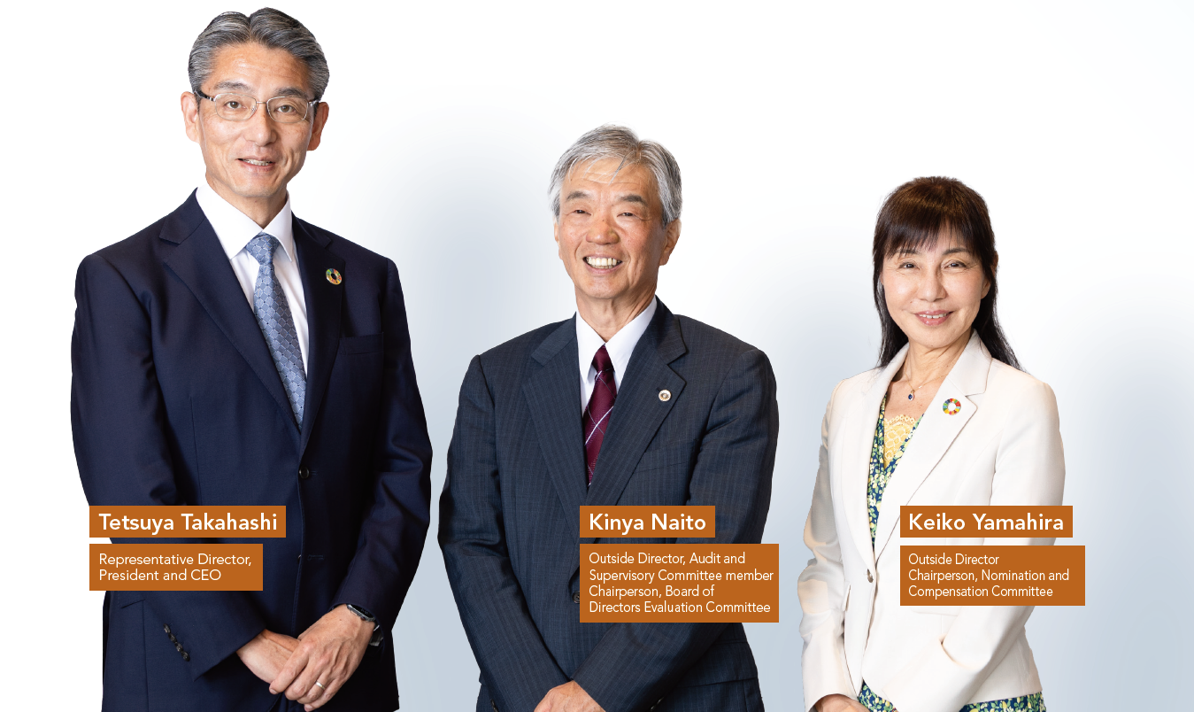
Naito: In 2025, Joshin changed our organizational structure and transitioned into a company with an Audit and Supervisory Committee. The Corporate Governance Code requires thorough discussion of medium- to long-term management strategy and basic company matters by the Board of Directors. Even when the Company had a Board of Auditors, there was still discussion pertaining to the formulation of medium-term management plans, but discussion of management strategy was lacking due to time constraints. I believe the current Chair (who was company president at the time) was the person with the greatest sense of urgency with respect to this matter. Now that the organizational structure has been changed, most of the authority over business execution decisions has been transferred to the Board of Executive Officers, so the Board of Directors is freed up to focus on discussions about management strategy and similar issues.
Yamahira: Although we have been working to transfer authority to the execution departments since the Board of Auditors era, we felt we had to change the Board of Directors’ agenda for aspects related to board approval standards and especially management strategy and management fundamentals. After COVID-19 pandemicrelated government cash payments in FY2020 gave a major boost to our performance, we experienced an ongoing decline that presented an opportunity for discussions of management strategy fundamentals and creative measures to bolster monitoring functions. I believe it is important for us to evolve from managing to monitoring, and to conduct deeper discussions that include capital policy, growth strategy, and HR strategy.
Takahashi: My biggest feeling was that the Company needs to change. That means we need to further leverage outside director expertise to draw out new insights while thinking about medium- to long-term strategy. It was precisely then that the current Chair came to me with the idea of speeding up decision-making by separating execution and supervisory functions. After much discussion between the two of us, we decided to change the organizational structure. I strongly believe that we must take this opportunity to achieve quicker decisionmaking and build management that is not afraid of change.
Naito: Joshin’s Board of Directors is not strictly management- or monitoring-focused, but instead a hybrid of the two. In the evaluation of performance for the purpose of individual performance-linked compensation for directors and auditors, we attempted to measure both management and monitoring contributions respectively. The monitoringrelated measurements were the most difficult. Considering all of that, we decided to shift entirely to a monitoring focus for the Board. So for me, the primary purpose of changing our organizational structure is to make the Board more specialized in monitoring functions.
Yamahira: Based on the last few years, I also think that we need to enhance our monitoring functions. The important roles of the Board of Directors are to thoroughly confirm whether the policies approved by the Board are being properly executed by the business-executing side and to steadily fulfill the promises made to the market. It is crucial that we cycle between these two roles more powerfully in the future.
Takahashi: In addition to strengthening the monitoring functions of the Board of Directors, all executive officers need to adopt a stronger “manager” mentality when performing their duties. Each and every executive officer needs to have the mindset to lead management by making their own judgments, making course corrections, and discovering new insights. This change in mindset will be the true key to transforming Joshin as a company.
Takahashi: The sense of urgency that I feel is one shared by the industry as a whole. Domestic, retail, and home appliance markets are all undergoing tough times. However, if we can raise profits and demonstrate strength even in those circumstances, then we can take on new challenges as well. I first want to establish clear results in the home appliances business, then lead the Company out from that business into adjacent sectors and new directions.
Yamahira: With population decline and other issues, the social environment is undergoing extremely rapid changes that require changes to the home appliance retailer business model. Joshin’s businesses can be divided into five categories. We believe it is essential to achieving sustainable company development for our future that we bolster the profitability of our core home appliances business and invest those funds in growth sectors.
Takahashi: Every customer has their own distinct needs, so I want us to be pursuing management that is capable of addressing all of those diverse needs. However, it is essential that we search out those needs by listening closely to opinions from the front lines, and ensuring collaboration between the Board of Executive Officers that acts to make those requests a reality and the Board of Directors that provides supervision. We also need the Board of Directors to be a solid, reliable presence that makes sound decisions. I believe we need to go back to our roots, engage the PDCA cycle, and achieve a type of management that can address diverse and ever-changing customer needs.
Naito: The core of the Company is, of course, home appliance sales. Joshin’s natural state of being is to be re-investing our profits from that business back into new lines of business.
Naito: I believe that Joshin’s future will be determined by how effectively we expand new lines of business centered on home appliances and related areas. I believe that the new company president’s vision is one of broadening our business domains, anchored in home appliances, to better serve consumers and society. Joshin is an exceptionally sincere and earnest company. Our sincerity is evident not only in our approach to environmental and human rights issues but also in the way we conduct business itself. The sense of trust and reassurance this provides to our investors is extremely important to the Company, and I believe we should highlight that more actively in our communications.
Yamahira: I also recognize that our real profit base is the home appliances business, and that securing profitability in this area will be the foundation for future growth. To respond to the many changes in the business environment ahead, bold management strategies and transformation of the business model will be essential. I believe we can achieve even greater profit growth by further developing our traditional sales approach and adding new value. The foundation of any growth strategy lies in the Company’s internal management resources: namely people, goods, capital, and information. Our company possesses a broad customer base and solid technological capabilities, and by leveraging these strengths, we can develop and advance concrete growth strategies. What I look forward to most is the new president’s leadership and decisiveness. Iexpect that through bold new initiatives that transcend our conventional frameworks, he will open up a new stage of growth for the Company.
Takahashi: As stated earlier, in today’s industrial landscape, the terms “domestic,” “retail,” and “home appliances” tend to carry a negative connotation, as they are often associated with the notion that products no longer sell due to Japan’s declining birthrate, aging population, and the resulting changes in consumer behavior. However, I believe there are still many opportunities to be found in these areas. For example, in an aging society, there is a growing need for “monitoring and protection” services, and we aim to develop lines of businesses that can fulfill this role using home appliances. Likewise, in the area of crime prevention, by leveraging IoT technologies, we can reliably deliver value that directly addresses customers’ real needs and concerns. Looking ahead, 2028 will mark the end of the next medium-term management plan. As we move toward that goal, we must both strengthen and stabilize the Company’s foundation while also exploring new business domains in earnest. We will proactively pursue market share in areas that are an extension of our current businesses, while also working to create new businesses that contribute to society. The key principles we aspire to uphold are speed, quality, and price. We are currently developing a sales support system that utilizes online technology to improve customer convenience and enhance productivity on the sales front lines. With a sense of speed in everything we do, we intend to tackle the challenges ahead with determination while maintaining quality and placing importance on price competitiveness.