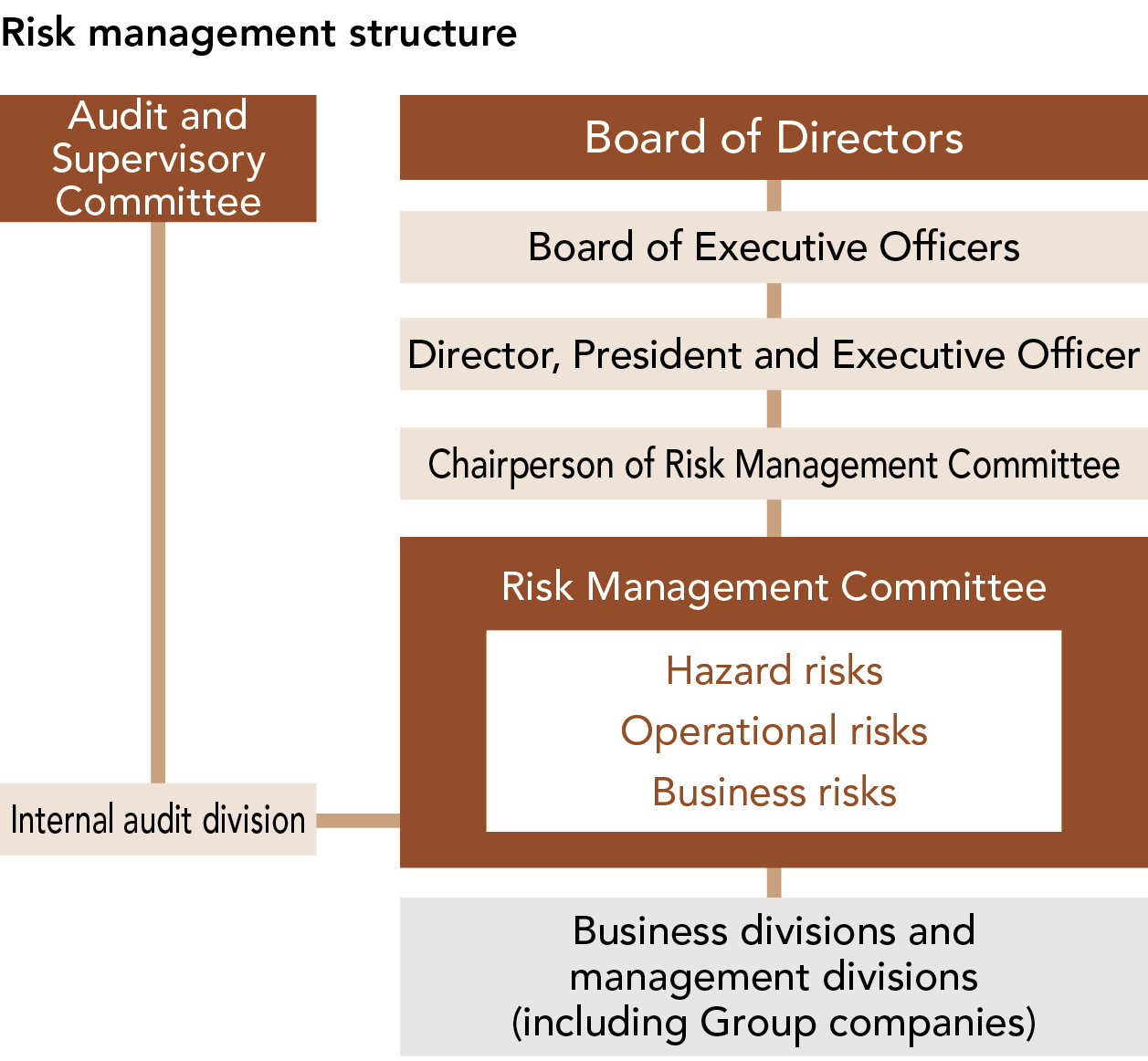
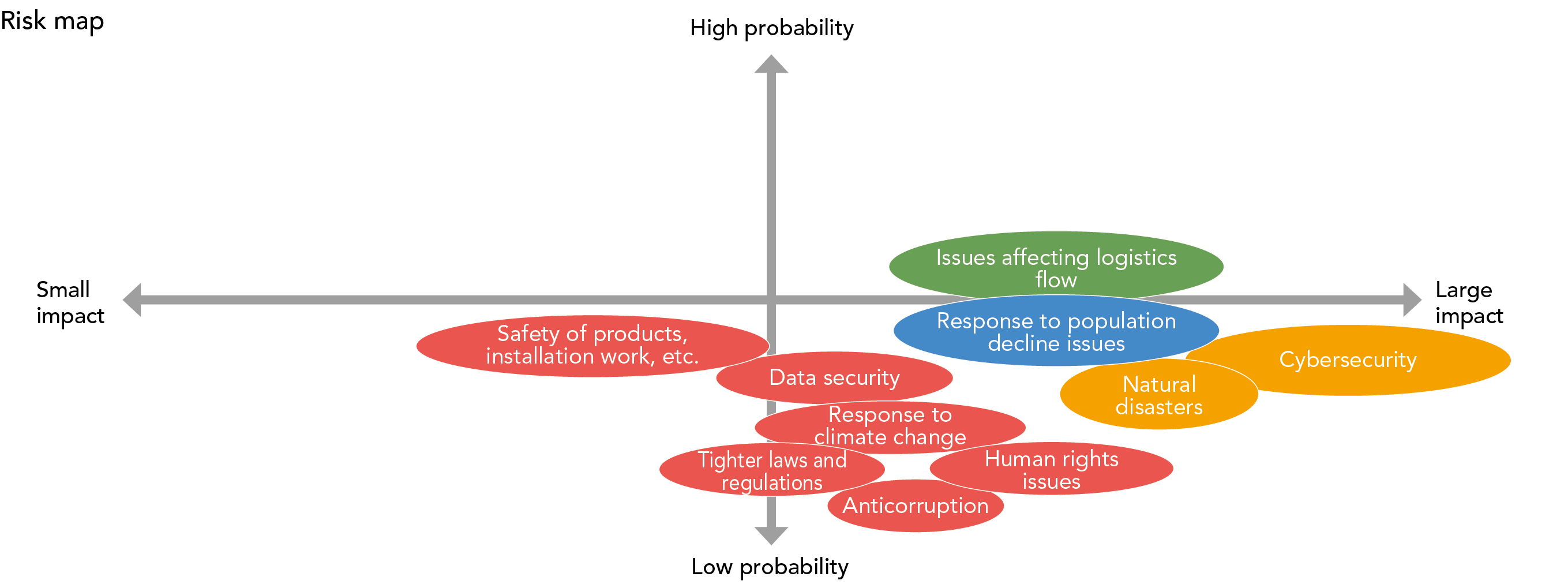
To identify, evaluate, and manage the various risks surrounding the Group in an integrated manner, the Company has established the Risk Management Committee and built an enterprise-wide risk management (ERM) system. Once a year, this Committee identifies and assesses risks that may interfere with achievement of the targets in the new JT-2028 Management Plan (medium-term management plan) and other risks that could impact the Group, and continuously monitors the status of our response to high-priority risks. Chaired by the Director, President and Executive Officer, the Risk Management Committee is comprised of executive directors, executive officers, directors who are full-time members of the Audit and Supervisory Committee, heads of divisions (including officers at subsidiary companies), and labor union representatives. The Committee comprehensively analyzes and manages hazard risks, operational risks, and business risks that threaten the Company’s efforts to maintain and continue business management, and it plays a central role in providing a strong underpinning to our stable management foundations.
*Click here the system . Click here an overview of the committees.
|
Classification |
Risk issues (content) |
Countermeasure |
|
Hazard risks |
Natural disasters, epidemics, and fires in important facilities |
• Formulation of basic business continuity policy and its communication to all employees throughout the Group |
|
• Acquisition of ISO 22301 certification, the international standard for business continuity management systems |
||
|
• Review of business continuity plans (BCPs) and disaster countermeasure manuals, as necessary |
||
|
• Continuing drills and training based on BCPs and disaster countermeasure manuals |
||
|
Increased importance of cybersecurity |
• Prevention of network attacks and intrusions using firewalls and other means |
|
|
• Constant EDR/MDR monitoring of all business terminals and servers, including those in remote work environments |
||
|
• Ongoing targeted email attack training for all Group employees |
||
|
• Ongoing maintenance of website safety based on results of website vulnerability evaluations |
||
|
Operational risks |
Issues affecting logistics flow |
• Promotion of automation and labor savings using IT systems |
|
• Rapid response to laws related to work-style reform and other legislation in coordination with contractors and the supply chain |
||
|
Business risks |
Response to population decline issues |
• Promotion of streamlining, automation, and labor savings for store operations by proactively using ICT |